
HOS
Adverse driving conditions exception: when bad weather gives you 2 more hours
November 16, 2026


The adverse driving conditions exception adds up to 2 driving hours in surprise snow, fog or closures. What counts, a clocked example, how to log it.
By Alex Smith
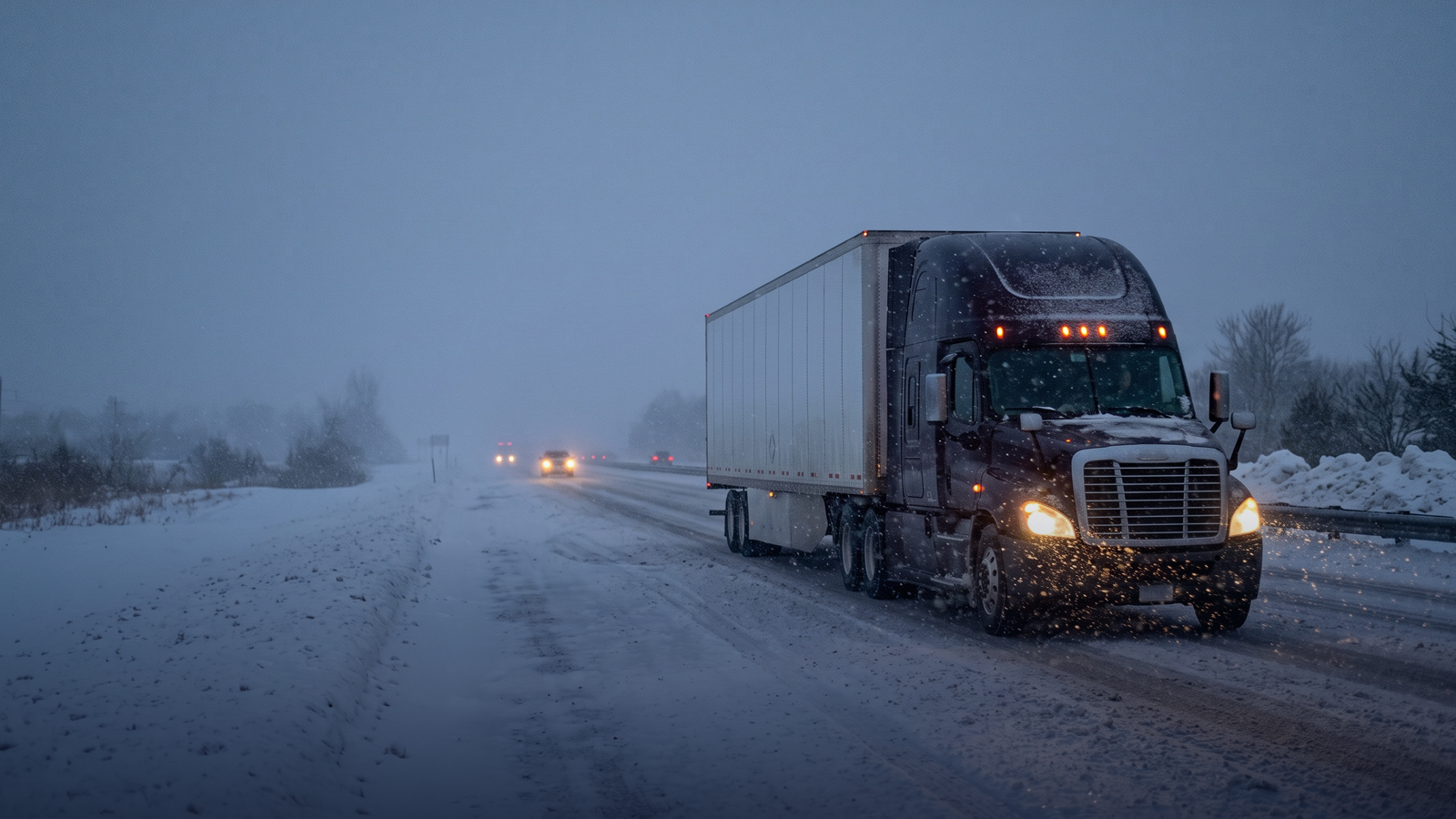
The adverse driving conditions exception lets a truck driver drive up to 2 extra hours, 13 instead of 11. It applies when snow, ice, fog or an unusual road or traffic problem shows up that nobody could have known about before dispatch. The 14-hour driving window stretches by the same 2 hours. The 60/70-hour limits do not move.
As of November 16, 2026, the rule is 49 CFR 395.1(b)(1) and the definition sits in §395.2. This guide covers property-carrying drivers.
What the exception changes, and what it doesn't
| Limit | Normal day | With the exception |
|---|---|---|
| Driving time | 11 hours | Up to 13 hours |
| Driving window after coming on duty | 14 hours | Up to 16 hours |
| 60 hours in 7 days, 70 in 8 | 60 / 70 | No change |
| 30-minute break after 8 hours of driving | Required | Not waived |
The normal limits are in §395.3. The Federal Motor Carrier Safety Administration (FMCSA) confirms the 13 hours and the longer window in its 2022 driver's guide. The same guide says the extension does not "increase any available driving time limits beyond the current 60/7 and 70/8 day limits."
The break line is our reading: the rule adds hours and says nothing that removes the break.
The window part is newer. A 2020 final rule, in effect since September 29, 2020, added it. Some guides still say you can't drive past the 14th hour. So does one FMCSA answer from 1997 that is still online. That was the rule before 2020.
The extra time has one purpose: finishing the run, or reaching a safe place for the driver, the truck and the cargo.
What counts as adverse driving conditions
Adverse driving conditions are weather, or unusual road or traffic conditions, that the driver and the carrier did not know about and could not reasonably have known about.
The knowledge test has set checkpoints. For the driver it is the start of the duty day, or the moment they start driving again after a qualifying rest. For the carrier it is the moment of dispatch.
| Situation | Counts? | Why |
|---|---|---|
| Snow squall that was not in the forecast when you started | Yes | Weather nobody could have known about |
| Storm forecast for your route the night before | No | Known before the duty day began |
| Highway closed by a crash ahead of you | Yes | FMCSA's own example |
| Ordinary rush-hour congestion | No | FMCSA excludes "typical 'rush hour' periods" |
| Rock slide already cleared, traffic still backed up | Yes | The backup held you up (FMCSA) |
| Storm begins during your 10-hour break and you see it before rolling | No | The checkpoint reset after your rest |
| Dispatched after the office knew about the closure | No | FMCSA guidance |
A qualifying rest is a 10-hour break or one of the two sleeper-berth split periods. The 30-minute break is not one, FMCSA says.
One more condition comes from FMCSA's 1997 guidance, linked in the table. The trip must be one that "could normally and reasonably have been completed without a violation."
A December day on the clock
Example: Tuesday, December 8, 2026. The plan is 10 hours 30 minutes of driving, with arrival at 4:30 p.m.
| Time | What happens | Driving so far |
|---|---|---|
| 5:00 a.m. | On duty after 10 hours off; pre-trip | 0 |
| 5:30–10:30 a.m. | Drive | 5 h |
| 10:30–11:00 a.m. | 30-minute break | 5 h |
| 11:00 a.m.–1:30 p.m. | Drive | 7 h 30 min |
| 1:30–3:00 p.m. | Unforecast squall and a crash ahead; a 30-minute stretch takes 90 minutes | 9 h |
| 3:00–5:00 p.m. | Drive | 11 h |
| 5:00–5:30 p.m. | Finish the run under the exception | 11 h 30 min |
The squall cost one hour. The driver needed 30 minutes past the 11th hour and stopped there. They parked 12 hours 30 minutes after coming on duty, so the longer window was never used.
They could not have claimed a full 2 hours. FMCSA ties the extra time to the delay. Its answer: "If it only took an hour for the driver to get through the adverse driving condition, then that is all the additional time the driver is allowed."
How to log it
- Annotate the log when you use the exception. FMCSA requires the note on an electronic logging device (ELD) under §395.28(c).
- Write what, where and when. For example: "I-80 closed by crash near mile 255, 1:30–3:00 p.m." FMCSA's guide asks for "details about the condition."
- Tell the office the same day.
- Stop when the run is done or you reach a safe place.
Watch out: Short-haul drivers can use the exception too. If it keeps you from getting back within 14 hours, FMCSA says you need a full log for that day. See how short-haul and other ELD exemptions work.
What dispatchers and owners must do
The rule covers what a driver may "be permitted or required" to do, so the claim is the carrier's too.
- Check the forecast and road reports before dispatch. Save a screenshot with the time.
- Don't build a load that only works with 13 hours. The run has to fit the normal hours of service (HOS) rules on paper.
- Don't send a truck toward a closure you already know about. That driver gets no extra time.
- Review every annotated log the next morning.
- Keep the proof with the log: the road alert, photos, the driver's message.
Motion Fleet (Motion ELD) shows the office each driver's logs, available hours and HOS violations, so a day that ran past 11 hours is there to review.
If the claim doesn't hold up
FMCSA's answer is short: "If the roadside officer can prove there was no adverse driving condition, the driver should be cited" for the hours violation.
In 2026 the civil penalty cap is $4,812 for a driver and $19,246 per violation for a carrier, under Part 386, Appendix B. For your own case, ask FMCSA or a qualified professional.
Questions about logs for your trucks? Talk to the Motion Fleet team.
FAQ
How often can you use the adverse driving conditions exception?
There is no limit on how often. FMCSA says so, provided the exception "is used consistently with the definition" in 49 CFR 395.2. Each use has to pass the same tests: a real weather, road or traffic condition that nobody could have known about beforehand.
Do you always get the full 2 hours?
No. Two hours is the ceiling, not a bonus. FMCSA says drivers are allowed up to two more hours, and only as much as the condition took. If a closure held you for 45 minutes, plan on about 45 minutes of extra time.
Does the adverse driving conditions exception extend the 14-hour rule?
Yes, since September 29, 2020. The exception now adds up to 2 hours to the driving limit, so 11 becomes 13. It adds the same to the driving window, so driving can end as late as the 16th hour. Older pages that say it covers only driving time describe the rule before that change.
Is the exception the same as an emergency declaration?
No. An emergency declaration is separate relief under 49 CFR 390.23. It applies to carriers and drivers giving direct assistance in a declared emergency, and FMCSA lists the declarations on its emergency declarations page. The adverse driving conditions exception needs no declaration and applies to any run that meets the tests.
Updated: November 16, 2026
Sources
- 49 CFR 395.1(b)(1), adverse driving conditions (eCFR current as of November 12, 2026)
- 49 CFR 395.2, definitions
- 49 CFR 395.3, maximum driving time
- 49 CFR 395.28(c), ELD annotations
- FMCSA, Interstate Truck Driver's Guide to Hours of Service (April 28, 2022)
- FMCSA, 2020 HOS FAQ, Questions 11–15 and 21 (November 19, 2020)
- FMCSA guidance, §395.1 Questions 3 and 5 (1997)
- Federal Register, Hours of Service of Drivers final rule (June 1, 2020)
- 49 CFR Part 386, Appendix B, civil penalties (checked November 6, 2026)
- FMCSA, emergency declarations
What's next
Security
November 24, 2026
Cargo theft prevention for the 2026 holidays: a plan for small fleets
Fewer thefts, bigger losses: the 2026 holiday risk dates, an office checklist for fake pickups and hijacked carrier IDs, and who to call first.
DOT
November 21, 2026
Truck chain laws by state: winter 2026–27 rules, fines and what fleets should do
Where trucks must carry chains vs mount them in CO, WA, CA, OR, NV and WY, the fines, and why a forecast storm won't earn extra driving hours.

IFTA
November 18, 2026
How to calculate IFTA miles and tax by state (with a worked example)
The IFTA formula with the return's rounding rules, one truck's quarter worked through with credits and a surcharge, and the trip records auditors accept.